

01
A run fails
The webhook fires. Nazar groups related failures into one incident instead of five identical alerts.
Live now · free to start
Nazar turns failed GitHub Actions into draft PRs — fixed by Claude Code or Codex CLI on your own machine, on the subscription you already pay for. And everything you notice on your phone gets filed under the right project while you’re at it.
The 40-second version
A red GitHub Actions run, one tap, and a draft PR written by your own coding agent on your own machine.
100%
of your source code stays on your own machine. Always.
2
coding agents supported — Claude Code and Codex CLI.
1tap
from a red CI run to a draft PR on your machine.
The problem
CI breaks while you’re out and just sits there, red, until you get back to a keyboard. Same for the bug you hit mid-commute, the idea in the shower, the fix you thought of mid-meeting — they scatter across five apps and die in none of them.
01 — Incidents
Connect a GitHub webhook and failed runs stop being noise. Nazar correlates them into incidents and triages one to you — in Telegram or on the web. One tap runs your own coding agent against it, at home, and hands you a draft PR.
01
The webhook fires. Nazar groups related failures into one incident instead of five identical alerts.
02
The daemon opens an isolated git worktree on your machine and runs your agent there. Your working tree stays untouched.
03
You come back to a real draft PR to review. Snooze, close or reopen incidents as they come.
The economics
They run your agent in a cloud runner and meter it against API credits. Nazar runs it on your own machine, under your own Claude or Codex subscription — the one you are already paying for.
The bridge is the product. The inference is already yours.
02 — The bridge · Pro & Unlimited
A tiny open-source daemon links your repos to Nazar over an outbound-only WebSocket. No open ports, no inbound firewall holes — and your source code never touches our servers.
Install in two lines
$ uv tool install nazar-bridge$ nazar-bridge add ~/code/timbaPaste the token from your dashboard. Autostarts on Windows, macOS and Linux.
~/timba $ nazar-bridge tasksOpen in Timba · 3 tasks● bug Login redirect loops on Safari● todo Add rate-limit to /api/sync● note Idea: weekly digest email~/timba $ nazar-bridge done 1✓ closed · synced to your phone~/timba $ It can
Read only the repos you add, run your coding agent, stream its output back to you, and sync task status.
It can’t
Reach anything you didn’t add, accept an inbound connection, or upload your source code to us.
03 — Capture
One box for everything. Type it, record it with a live waveform, or drop a photo. Mixed-language voice works out of the box — Armenian and English in one breath — transcribed on our own Whisper servers, never a third-party API.
Read more04 — Organize
An LLM reads what you sent and proposes a note, a todo or a bug — with a project, a priority and tags. One tap to confirm or recategorize. Nothing is ever filed behind your back.
Read moreWhile being
A thought is filed before you’ve put your phone away.
Outbound-only bridge. Self-hosted transcription. No OpenAI on our servers.
Your machine, your repos, your API keys, your Claude account.
A chat app you already have, and a web dashboard that matches it.
05 — The product
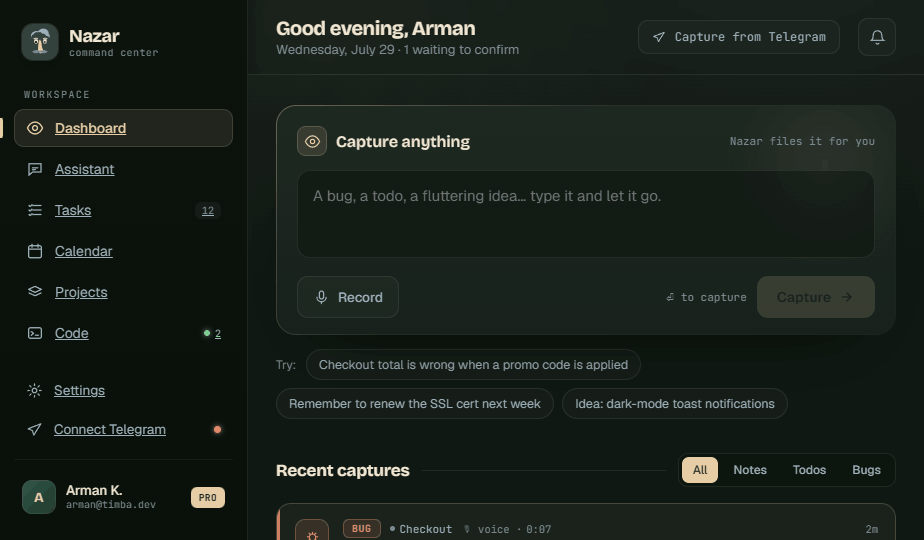
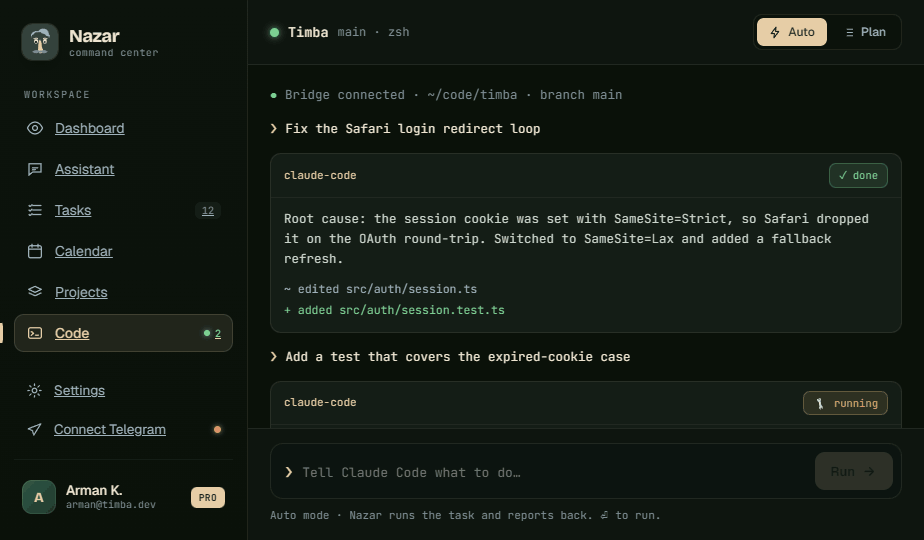
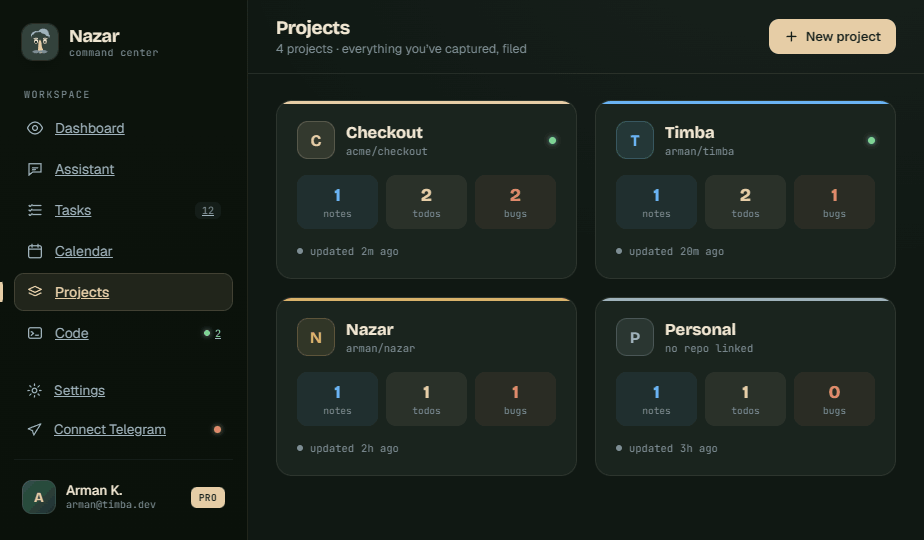
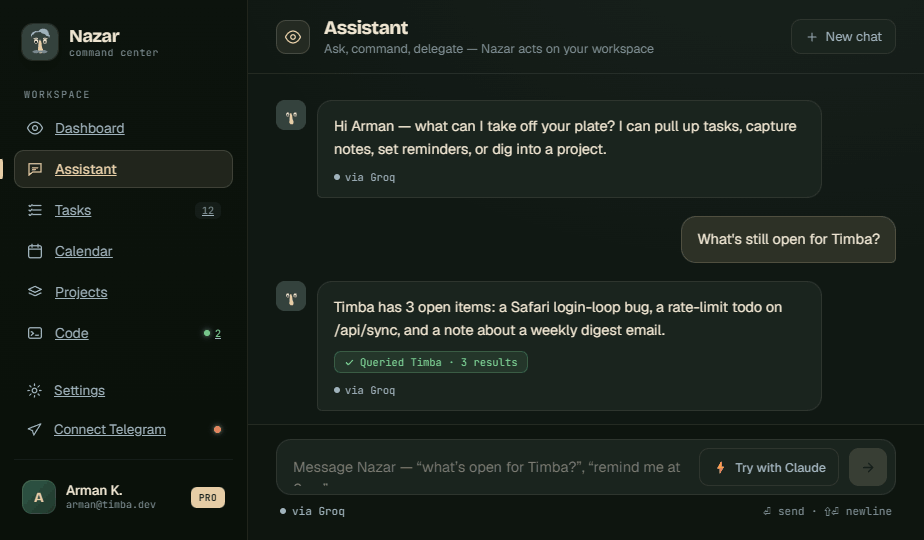
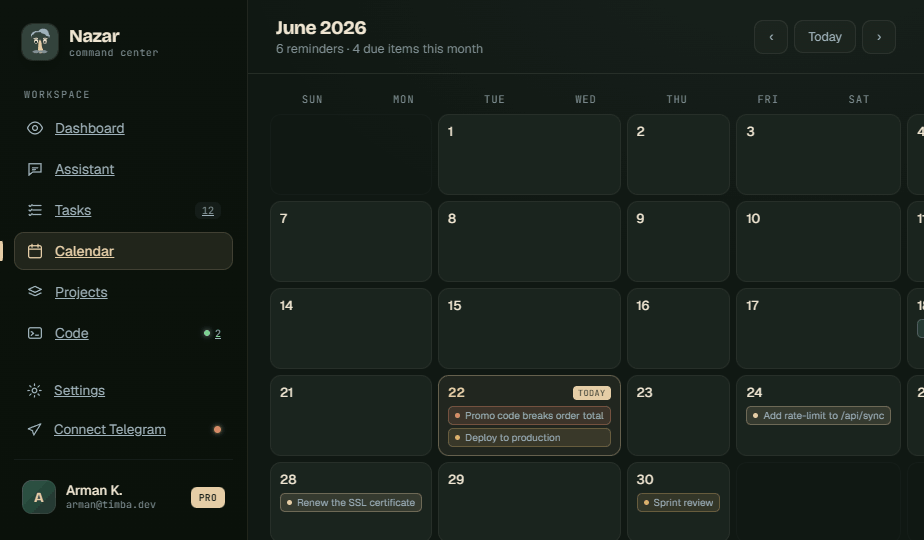
06 — Everything else
Capture, projects, the assistant and the whole Telegram client are unlimited on every tier — including Free. The bridge is what the paid plans add.
Ask and command in plain language, on web and in Telegram. It creates, edits, completes, refiles, searches and schedules — with multi-turn memory. Destructive actions always ask first.
Persistent memory of facts about you and how you work. Tell it to remember or forget something; edit the whole list in Settings → Memory.
Not a toy bot. Full capture with confirm cards, per-item buttons and undo — plus /today, /calendar, /tasks, /projects, /inbox, /reminders, assistant chat and /code mode.
Record with a live waveform on the web, or send a voice memo in Telegram. Self-hosted Whisper, never a third-party API — Armenian and English in one breath. Voice works as an assistant prompt too.
Per-project notes, todos and bugs. Subtasks, task dependencies, check-off, auto-archive on completion and one-click restore. Cross-cutting captures land in your inbox.
Every todo and bug across projects, filtered by Today, Open or Done. A month view of everything with a due date — and you can add a task straight from a day.
Reminders that ping you when they’re due, plus your day’s tasks delivered at a local time you pick — by web push, in Telegram, or both.
An in-app notification centre with full history: reminders, CI incidents, usage-limit resets and billing events. Miss a ping and it’s still there.
Sign in with email, Google or GitHub. Bring your own Groq or Anthropic key — encrypted at rest, never logged — and the Free-tier AI cap disappears.
07 — A day with Nazar
07:40 · on the street
You voice a feature idea, half in Armenian. It’s a classified todo in the right project before you’re home.
13:20 · on the couch
Telegram open, laptop shut. You tell Claude Code to fix a bug in the repo at home, read the diff it streams back, and close the task.
16:05 · out for coffee
CI fails. Nazar pings you with the incident; one tap drafts a fix PR on your own machine, in its own worktree.
18:30 · support inbox
A screenshot and a voice note from a user complaint become one filed bug, with the context intact.
08:00 · every morning
Your digest arrives in Telegram at the time you chose. You check three things off from chat before standup.
How it compares
| Capability | Nazar | Claude Code Remote Control | Claude Code / Codex GitHub Action | Mobile session apps |
|---|---|---|---|---|
| Works with no session already running | Yes | No | Yes | No |
| Failed CI → draft PR | Yes | No | Yes | No |
| Runs on your subscription, not metered API credits | Yes | Yes | No | Partial |
| Fix runs on your own machine | Yes | Yes | No | Partial |
| Capture and triage by voice, photo, text | Yes | No | No | Partial |
| Telegram-native, no new app | Yes | No | No | No |
| Live session monitoring and diff review | Partial | Yes | No | Yes |
| Works with both Claude Code and Codex | Yes | No | Partial | Partial |
Competitor capabilities as of July 30, 2026; this space moves fast — tell us if we’ve got something wrong.
08 — Pricing
Capture, projects, the assistant and Telegram are unlimited on every tier. Paid plans add the Claude Code bridge — more repos, more machines.
For trying it out
$0forever
For daily drivers
$11.99/mo
Cancel anytime — no lock-in.
For power users and many machines
$23.99/mo
Cancel anytime — no lock-in.
Yearly means you pay for ten months and get twelve. Upgrades are prorated. Go over your repo limit and the extra repos are locked, never deleted — nothing is lost when you downgrade.
Claude Code runs on your own Claude account. Nazar is the bridge, not the AI bill.
09 — Security & privacy
01
The daemon dials out to us. No inbound ports, no firewall holes — and your source code is never uploaded to or stored on our servers.
02
MIT-licensed on PyPI, published through GitHub Actions Trusted Publishing with signed attestations. Audit it, or build it yourself.
03
Voice runs through our own Whisper instance. Your audio is never handed to a third-party transcription API.
04
Groq’s open models by default, Claude on demand. That is the entire list. Codex CLI, if you use it, runs on your machine under your own auth.
05
Bring-your-own Groq and Anthropic keys are encrypted at rest, never logged, and used only for your own requests. Rotate or delete them anytime.
06
Per-user data isolation and JWT auth. OAuth tokens come back in URL fragments, so they never land in an access log.
Read the full Privacy Policy for the details.
10 — Answers
A small open-source daemon you install on your own machine with one command. You paste a token from your dashboard and register repos with nazar-bridge add. From then on, Nazar can pull a project’s open tasks into your terminal and drive Claude Code or Codex CLI on those repos — while you’re on your phone. It talks to us over an outbound-only WebSocket, so nothing has to be exposed to the internet.
No. A failed run arrives as an incident and “Draft a fix” starts a fresh session on your machine by itself — in an isolated git worktree, so whatever you had checked out stays exactly as you left it. You can be asleep; the daemon just has to be running.
Your repositories stay on your machine. The daemon runs locally, only touches the repos you explicitly add, and your source is never uploaded to or stored on our servers. It accepts no inbound connections. The captures you send us — text, voice, photos — do pass through Nazar so they can be classified; that is the one thing that leaves your devices.
Because those are two different places. Nazar’s own servers never call OpenAI: classification and the assistant run on Groq’s open models by default, with Claude on demand. Codex CLI is a coding agent that runs on your machine, under your auth, at your choice — the same way Claude Code does. Nothing about it changes what our servers talk to.
No. Capture, classification, projects, tasks, the calendar, reminders, the digest, the assistant, and the whole Telegram client work on their own — free, with no bridge installed. Claude Code (or Codex CLI) is only needed for the remote-coding half.
Nothing is deleted. Repos beyond your plan’s limit are simply locked until you upgrade or unlink one. Pro covers 3 repos on 1 machine; Unlimited covers 25 repos across 5 machines. Upgrades are prorated, and downgrading never loses data.
Yes — Groq or Anthropic. Keys are encrypted at rest, never logged, and used only for your own requests. On the Free plan your own key removes the 1,000-requests-per-month cap entirely. You can rotate or delete a key anytime in Settings.
No. Use the web dashboard, or Telegram — a chat app you already have. Text, voice memo, or photo, from anywhere. The only optional install is the bridge daemon, and that lives on your development machine, not your phone.
Mixed-language speech out of the box — Armenian and English in the same sentence, for example. You don’t flag anything; transcription handles the switch. The interface itself is available in English and Russian.
Monthly or yearly, and yearly is ten months’ price for twelve months. Payments go through AmeriaBank vPOS (Visa, Mastercard, ArCa, Amex, Mir) or Lemon Squeezy — card details never touch our servers. Cancel anytime, no lock-in; see the Refund Policy for specifics.
Sentry and Grafana joining GitHub CI as incident sources, a Jira integration, and a dedicated Alerts hub. Everything else described on this page is live today.
Nazar is live and free to start — no card required. Your first project takes about a minute.